
Blake Gendebien Running To Replace Stefanik, Affordability A Key Issue
About a 4 minute read.

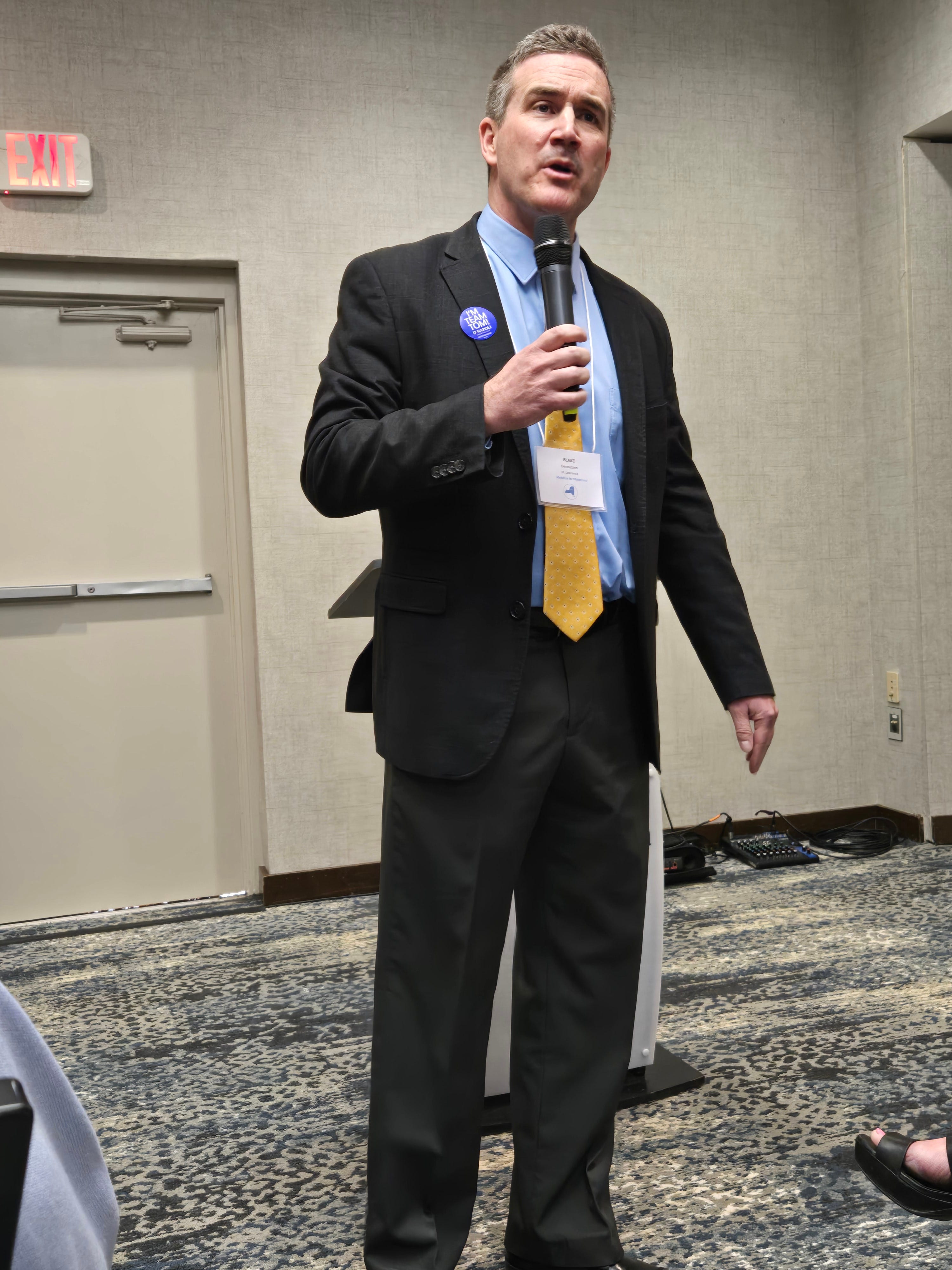
Blake Gendebien, a dairy farmer from Lisbon, NY, is running to replace Elise Stefanik as the Member of Congress representing NY-21, my district. Since his initial run last year to replace Stefanik when Trump tapped her to become U.N. Ambassador, we have gotten to know each other and have become friends.
As is well-known, Trump pulled that nomination in order to keep Stefanik in the House and maintain his razor-thin majority backing. Stefanik had already completed a farewell tour of the district. I’m guessing for many, this was also the first time they’d met her since she’d rarely been here throughout her tenure as our Representative.
In fact, when Trump un-nominated her, Stefanik tossed an insult at her constituents when she said she would “take one for the team” and stay in the House. For a decade, she opened virtually every comment with how deeply honored she was to serve as the Representative from NY-21. Quite a change to say she’d take one for the team to continue in that “honored” capacity.
Before Trump called upon Stefanik to publicly acknowledge what everyone already knew about her priorities - that she placed fealty to Trump above any concerns about her constituents - there was a special election underway to replace her. Blake emerged as the presumptive Democratic nominee to replace her. Once she “took one for the team” (am I saying that too much? …. nah) that ended and attention shifted to the November mid-term election to determine who would represent NY-21.
Blake stayed in.
There are many fundamental “kitchen table” issues at stake in this election. Blake, as a farmer and at the forefront of the growing crisis in food affordability, is focusing on how the Trump administration’s policies are hurting people, not just in this Congressional district but across the country. The importance of this issue is underscored by a piece in the British news outlet, The Guardian, that featured Blake as one of three farmers in the US profiled as directly dealing with the fallout from Trump’s war with Iran and rising fuel costs.
“These rising costs are hitting us at the wrong time here in the north country in New York,” said Blake Gendebien, who owns a 1,200-acre dairy farm with 500 cows in Lisbon, New York. “I use 20,000 gallons of fuel to get my crops in the ground and harvested.”
Last April, he paid about $2.65 a gallon for off-road diesel. Off-road diesel is for vehicles used off public roads and is therefore exempt from federal and state excise taxes. Depending on the state, it can be anywhere between $0.20 and $0.80 cheaper a gallon than on-road diesel.
This year, it’s pushing $5 a gallon. According to the most recent statistics, 86% of farmers in America run small family farms, defined as having a gross income of $350,000 a year or less. And the majority of those farms have high-risk profit margins of 10% or less. So rising diesel costs pose a serious threat to their ability to stay in business.
“It’s a massive cost for farmers that are already barely, barely getting by,” Gendebien said.
Family farming, always a difficult business dependent on so many things beyond farmers’ control, has become an even more economically perilous proposition in the Trump era. Fuel to run equipment must be purchased regardless of cost. To weather increased fuel costs, they must limit other spending. But they end up passing along some of the costs to consumers, feeding rising food costs for everyone.
And it’s harder for small Black-owned farms. As noted in the Guardian:
According to the 2022 Census of Agriculture, 55% of Black-operated farms earned less than $5,000 a year, compared with 41% of all farms. Only 12% made $100,000 or more. From 2017 to 2022, the number of all farmers fell by 4% to fewer than 47,000 producers. Black-operated farms declined even more, falling by 8%. Of the 1.9m farms, only 32,600 were Black-operated. (Critics suggest that the census overcounts Black farmers by a significant amount, placing the actual number of Black-operated farms anywhere between 5,000 to 18,000.)
Black farmers also have greater credit issues, so relying on credit to buy fuel isn’t an option.
Even under the Biden administration, the USDA only provided direct loans to 36% of Black farmers who applied as against 72% of white farmers. The Trump administration, in its vocal push to eliminate federal programs that attempt to address gaps in equity, has gone even further, most recently canceling a $300m program designed to help Black farmers and other underrepresented groups increase capital and prevent land loss. Letters informing grantees of the cancelation cited “discriminatory preferences based on diversity, equity and inclusion”.
The Guardian notes Blake’s belief that there’s a large disconnect between rural America and Washington.
“We don’t have enough farmers in Congress,” he said. “We don’t even have a farm bill.” (The House passed its version of a farm bill on 30 April, and the Senate is expected to introduce its own version in the coming weeks.)
That’s why he is running for Congress against Elise Stefanik, he said. “It would be so nice to have a congressman from the north country here that understands the beginning of food production at the farm gate all the way to the dinner plate.”
An end to the war with Iran will eventually help reduce the escalating cost of fuel. Beyond that, farmers have limited options to mitigate the costs of farming in America.
“One thing that we could do really quickly is end the tariff war,” Gendebien said. “We would rather make money on our own through fair trade, rather than have our friends and neighbors and their tax dollars have to help us.”
Mid-term elections are fast approaching. It’s up to us to seize this critical moment to send farmers like Blake, and other candidates who truly represent working American families, to Washington.
We must not fail.
Thank you, Alan. Just to say, I like Blake very much--that he is part of the community, coaches in the school, represents farmers in an organization, works on children's health--is a good caring person. But I wonder what he feels about solar and wind (and green energy) and our climate crisis, about factory farms, corn ethanol, regenerative agriculture. about the rule of law, protest, speech, our environment, democracy, about corruption, greed, income inequality.. ...I just wrote another letter to the Post Star recognizing "affordability" and "the economy," but wanting a strong voice naming what is true (about corruption and imperial power) and fighting for what is good in terms of how this regime hurts and harms so many.
I agree we need a farmer in congress representing NY-21. I live in NY-21 and have followed the elections for this area since 2009 (NY-23 at the time), when Democrat Bill Owens won in a special election. I think Blake will do well if he offers his ideas for solutions to the issues he raises. He’s been very vague in his statements, media interviews, doesn’t answer direct questions from constituents and has declined a debate with Stuart Amoriell. He needs to offer more if he wants to get to Washington.