
Declaration of Grievances
About a 4 minute read.

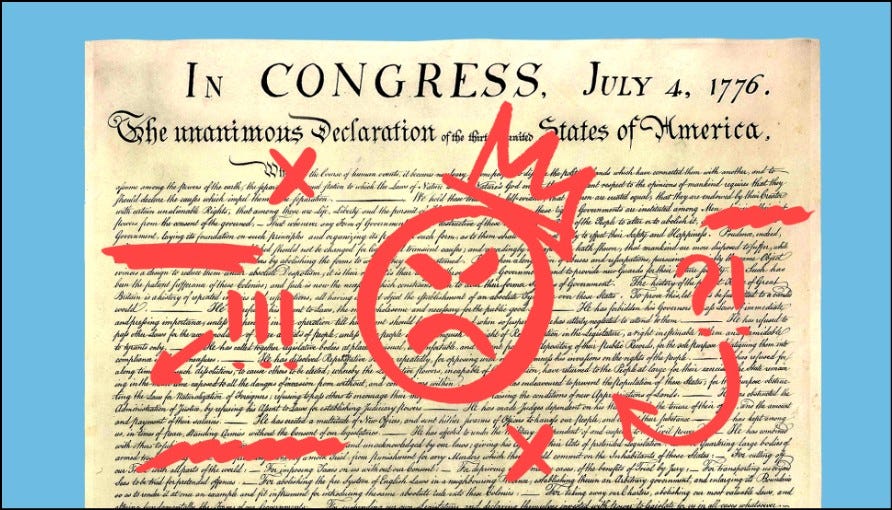
In an important piece for the National Constitution Center, Rosemarie Zagarri, Distinguished University Professor, George Mason University, discusses an often overlooked part of the Declaration of Independence, a list of 27 grievances against King George. The grievances laid out the core of the colonists’ case against Great Britain. She notes that “… this section is at once the most overlooked part of the Declaration and the least well-understood. Yet at the time it was written in 1776, the list was arguably the most critical section of the document.”
The list was drafted by a Committee of Five, composed of John Adams, Benjamin Franklin, Thomas Jefferson, Robert Livingston, and Roger Sherman. In it, the Committee established that the relationship between king and colonists was a reciprocal one. Subjects owed their rulers duty, service, and allegiance. Rulers had specific obligations to the people, including a duty to protect their “unalienable rights.”
These rights, as the Preamble states, include the self-evident truths that all people are created equal and their unalienable rights include life, liberty and the pursuit of happiness. It’s important to recognize that “happiness” in this context did not then, and does not now, refer to the individual emotion of joy or pleasure. Instead, when Jefferson used the phrase, he considered the “pursuit of happiness” to describe a collective status produced by a government that protects, and provides for the people’s safety, security, and general welfare.
The List of Grievances was documentation of the ways in which King George had violated his compact with the colonists to protect their rights and thus was unfit to be the ruler of a free people. Once a ruler had become a tyrant, the people not only had the “right” but also had the “duty” to overthrow their government.
The simultaneously simple and profound words, “We hold these truths to be self-evident, that all men are created equal, that they are endowed by their Creator with certain unalienable Rights, that among these are Life, Liberty and the pursuit of Happiness” not only stated the principles on which the Revolution was fought, they have stood as the central pillar of our democracy. One of my favorite quotes from Mark Twain asserts, , “Patriotism is supporting your country all the time, and your government when it deserves it,”
OK, getting to the point of all this. We are clearly in a time when our government has abandoned our founding principles. We have never, from the start, fully lived up to them, and we have frequently strayed afar. Never, until now, have we gotten as close as we are to losing what the Revolution was fought for.
Not all of the grievances the Committee of Five laid out against the 18th Century’s actual King have direct parallels with those we hold against the 21st Century’s wannabe pretend “king’s", but several do.
The first twelve grievances in the Declaration identified Britain’s particular actions and policies that threatened various aspects of the colonists’ collective “happiness.” In Jefferson’s terms this means people’s safety, security, and general welfare. Donald Trump’s stock-in-trade is to keep people confused, insecure, uncertain, afraid, and unhappy. As with any bully, it’s how he asserts his dominance and power. He uses his power to keep his allies and followers in line, to cow foreign governments, and to intimidate opponents.
Grievance # 7 in the Declaration charged that the King had obstructed the Laws for Naturalization of Foreigners and refused to encourage migrations to the colonies. There had been a large influx of German immigrants to America, and the King wanted to discourage such immigration. Trump’s selective denigration of immigrants from countries he does not like is no different.
Grievance #10 charged that the King had “erected a multitude of New Offices, and sent hither swarms of Officers to harass our people and eat out their substance.” After the passage of the Stamp Act, the Crown appointed stamp distributors in towns across the Colonies. These created “swarms of officers”, all of whom received high salaries. The high salaries and extensive perquisites of all of these were paid with the people’s money, and thus “swarms of officers, ate out their substance.” DOGE ate out the substance of our government.
Grievance #11 charged the Crown with keeping “among us, in times of Peace” a standing army without the consent of our legislatures.” While the National Guard is not a “standing army,” the parallel is clear. King George sent 40,000 British troops as well as mercenaries from Germany with the intent of quelling protest among the colonists. Trump is sending “his” army to cities for the same reason.
Grievance #12 charged the King had “rendered the Military independent of and superior to the Civil Power.” Trump has bypassed Congressional authority and declared his own war on Venezuela.
Grievance # 19 charged the Crown with “transporting us beyond Seas to be tried for pretended offenses.” In 1744, a law in Massachusetts , known as the Administration of Justice Act, provided that in particular cases, including an indictment for riot, the resistance of the magistrate, or impeding the revenue laws in the smallest degree, he might be taken to another colony, or transported from the colonies, for trial. Trump’s extralegal arrest and deportation of persons, including citizens, for incarceration in other countries is no different.
These are serious grievances, and there are more parallels not included here, laid at the feet of Donald Trump. He continues to commit egregious acts that defy and defile the rights of people and, in the extreme, extend to crimes against humanity.
These were wrong in 1776 and they are wrong today.
It’s up to us to continue to call him out for the tyrant he is.